
At the end of my last experiment, I asked how many genuinely different analytical angles it would take before ten independent passes became more valuable than one strong general critic, re-run ten times.
But I knew that for most people, the actual real-life benchmark is different: “why not just ask Fable?”
So I did.
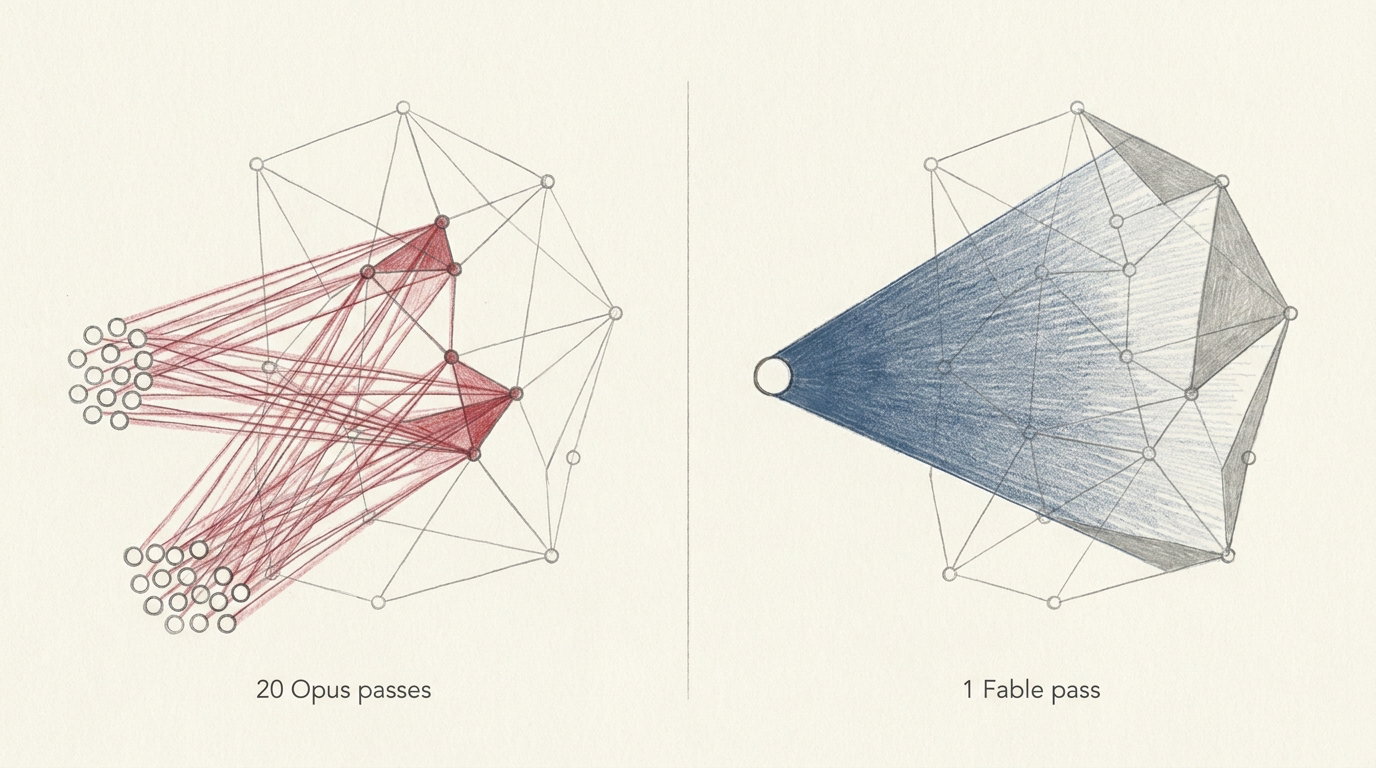
I added a post-hoc third condition after the original experiment had closed: one uncapped pass from Fable 5, a frontier top-tier model, against the same fictional acquisition case previously read by Opus 4.5, the middle-tier model in this setup. It was not a new ingenious prompt. It used the same broad critic prompt, with only the length clause changed from a short cap to an instruction to be exhaustive. Same documents. Same closed-world context. Same frozen scoring instrument.
The result was jaw-dropping: one Fable pass beat each ten-call Opus ensemble. More strikingly, it beat all twenty Opus calls pooled together on distinct strict catches.
This was one Fable call against twenty Opus calls, and the one call found more.
That is a serious result. It is also post-hoc, not pre-registered, n = 1, and confounded by the removal of the word cap. It should change the next experiment, not end the research program.
The result, stated plainly
At the far end of the one-big-pass spectrum, Fable did not merely keep up. It changed the scale of the comparison.
The original study compared two ten-call Opus ensembles. One reran the same general critic prompt ten times. The other used ten separately instructed analytical passes. Both read the same case, under the same cap, in fresh contexts.
The general critic found more distinct problems. The engineered passes repeated one another less. That left an open question about whether diverse attention would eventually beat repeated general intelligence.
The new added comparison (”Arm C”) pushed on that question from the opposite direction. Instead of adding more passes, I upgraded the model and let one response run long.
The Fable output was 8,786 words. The ten engineered Opus passes produced 11,758 words in total. The ten general Opus reruns produced 20,380.
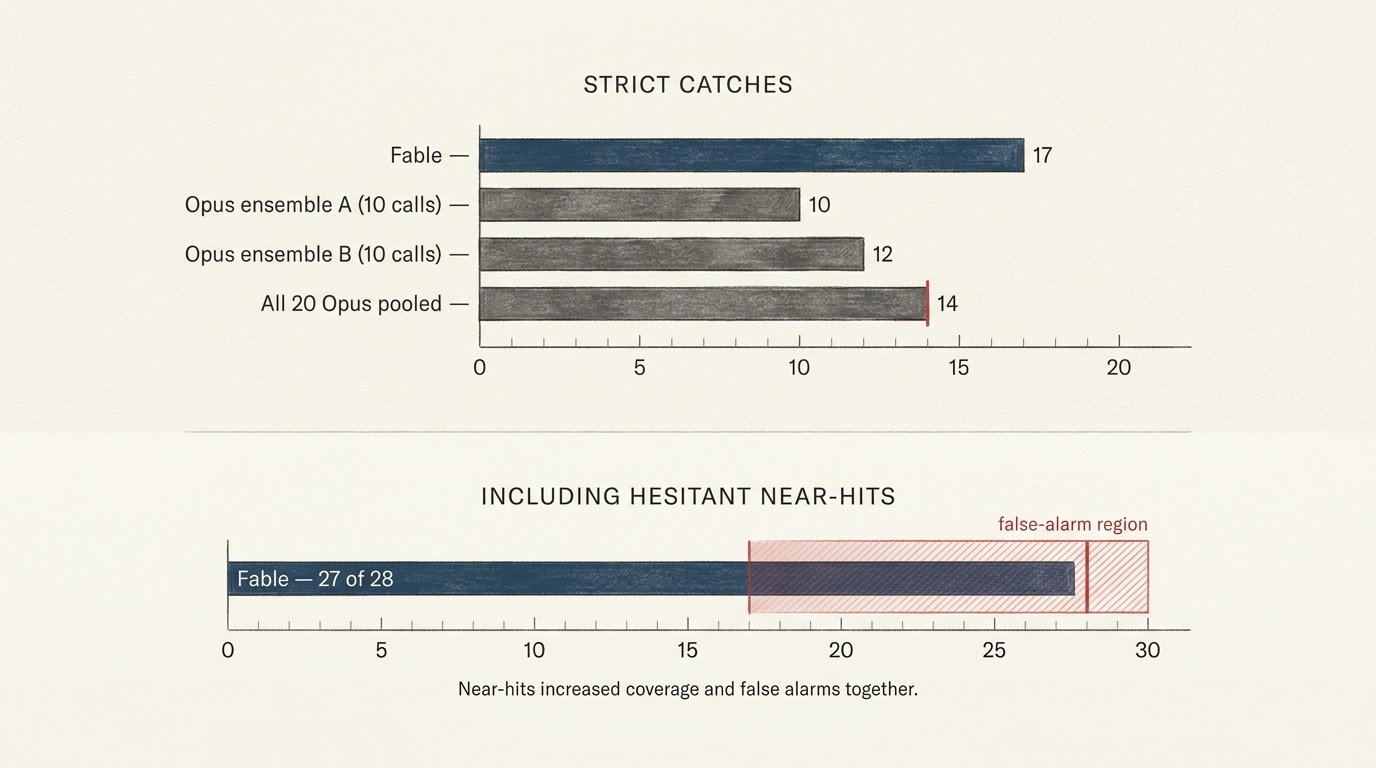
Under the strict scoring rule, Fable caught 17 planted flaws. The two Opus ensembles reached 10 and 12 respectively. Pool all twenty Opus calls and their strict union was 14. One Fable call still found more distinct flaws.
So the comparison was better than 10:1 in call-count terms. Fable beat either ten-call arm, then beat both arms combined.
This is not an absolute claim that Fable is "better at reasoning" by some universal amount. It is one observation on one corpus under one instrument. But it is equally wrong to hide the model change inside the phrase "one long pass." This was Fable, not Opus. Frontier model capability was part of the intervention, and probably a large part.
Almost everything, with an important asterisk
When hesitation was counted as evidence of a near-hit, Fable reached almost the entire hidden problem set.
I scored the experiment in two ways.
The strict rule counted a flaw only when the grader said the output cleared the pre-written binary bar and did not hedge. That is the 17-flaw result.
The hesitant-inclusive rule also counted a finding when the grader stopped just short of awarding the hit but explicitly marked it as a plausible near-hit. Under that rule, Fable reached 27 of the 28 planted flaws.
That is extraordinary coverage from one ask. It is also not the number I would put alone in a headline.
The same grader hedged on 42.5% of all arm C marks, far more often than on the shorter Opus outputs graded in the same package. Counting hesitation raised flaw coverage, but it also raised false alarms. Under the inclusive rule, Fable challenged 75% of the sound controls that were supposed to remain standing.
Under strict scoring, its false-kill rate was 16.7%. The engineered Opus ensemble's was 0%, and the general Opus ensemble's was 2.5% across its control marks. The denominators differ sharply, so these are not stable population estimates. They still show the trade: Fable bought breadth partly by becoming more willing to accuse.
The honest way to read both numbers is this: 17 is the defensible catch count. Twenty-seven tells us Fable was engaging with almost every hidden issue, often getting close enough that the grader hesitated, but not always composing the exact evidence and consequence required for strict credit.
That distinction matters. A model can see the ingredients of a problem without completing the judgment.
What Fable caught, and where ensembles still matter
Fable dominated the broad middle; the ensembles remained competitive on the hardest composite judgments.
I am not publishing the hidden answer key, but the qualitative pattern is clear.
Fable was exceptionally good at accumulation. It carried changing definitions, figures, provenance, timing, and downstream consequences across a long set of documents. It found several problems no individual Opus output had fully stated, including issues that required connecting a premise in one document to a cost or contradiction elsewhere.
A single continuous context has an obvious advantage here. Nothing has to be handed between agents. An observation made early remains available when later evidence changes its meaning. There is no coordination tax and no chance that a synthesis step will accidentally sand off the one unusual finding.
The pattern narrowed on the hardest findings. These required several facts to be joined into one exact consequence, sometimes with a magnitude or a dominating alternative stated in the same argument. On those, the Fable pass matched rather than clearly surpassed what the pooled ensembles achieved.
The long pass also did not solve negative space. Some of the hardest flaws were entire categories absent from the documents. Exhaustive reading can cover everything written and still miss what was never written at all.
That gives ensembles a more demanding job description. They should not exist merely to generate more findings. They need to force genuinely different searches, preserve rare observations, target missing regions, and assemble difficult conjunctions without collapsing into consensus.
What I would do with a real decision today
Use one frontier pass for breadth, then spend additional calls where independence can change the verdict.
A few practical rules now look defensible:
- If the budget buys only one pass, use the strongest model available and let it be exhaustive. Give it the full record and enough room to finish. A short output cap may save tokens by deleting the part where the reasoning becomes useful.
- Do not spend ten calls merely rerunning a weaker model. In this test, one frontier pass covered more distinct ground than twenty middle-tier calls pooled.
- Use independent passes selectively. Reserve them for high-stakes compound claims, missing stakeholder or cost categories, and places where one coherent narrative may be overconfident.
- Add synthesis without deleting disagreement. Preserve unique findings, unresolved conflicts, and minority objections. Consensus is not the same as coverage.
- Measure false alarms. Seed the review with claims you have independently checked. A critic that attacks every sound statement technically never misses and practically cannot be used.
- Ask what is absent. Run a separate pass on which stakeholders, costs, alternatives, or constraints should be present but are not.
- Keep the verdict human. A frontier model can widen and stress-test the map. It cannot inherit responsibility for the decision.
Is Fable already a society of thought?
The strategic question is whether frontier models are internalizing the very diversity that external orchestration was meant to provide.
Why did Fable outperform so dramatically?
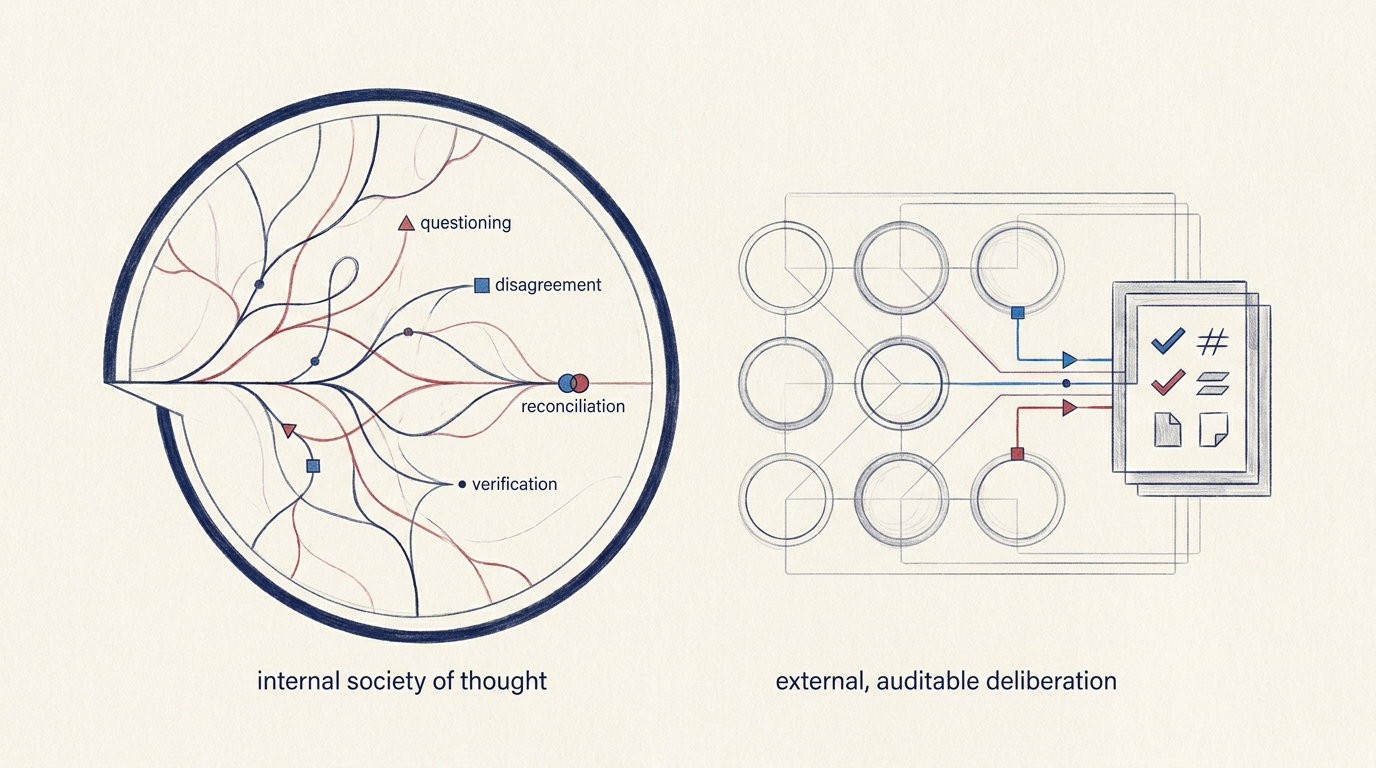
Length is one candidate explanation. Model capability is another. But a January 2026 paper gives the more interesting possibility a real empirical basis. In Reasoning Models Generate Societies of Thought, Junsol Kim and colleagues argue that reasoning-optimized models do not merely produce longer chains of thought. They increasingly organize those traces like conversations among differentiated internal perspectives.
Across thousands of benchmark problems, the reasoning models they studied showed more self-questioning, perspective shifts, conflict, reconciliation, and distinct implicit voices than instruction-tuned comparison models. Crucially, those differences remained after controlling for trace length. The claim is not simply that better models think for longer. It is that they may structure that extra computation socially.
The paper also tries to move beyond surface resemblance. In one mechanistic experiment, steering a feature associated with conversational surprise and perspective change roughly doubled accuracy on a multi-step counting task, partly by increasing verification and backward reasoning. In separate reinforcement-learning experiments, small models rewarded only for correct answers spontaneously developed more conversational behavior, while models first trained on dialogue-like reasoning learned faster than models trained on equally correct monologues. The effect also transferred from arithmetic to a misinformation-detection task.
That is unusually relevant to arm C. Fable may have outperformed not only because it was stronger or allowed to write more, but because a frontier reasoning model can potentially generate, challenge, and reconcile several lines of thought inside one trajectory. If so, the comparison was never really twenty minds against one. It was twenty externally separated Opus passes against one Fable pass that may already have contained a hidden internal debate.
But the paper does not establish that explanation for my result. It did not study Fable. Its causal experiments used smaller open models and bounded tasks. My arm C result is one post-hoc draw that changed model class and length budget together, and I cannot inspect whether Fable actually produced differentiated internal perspectives. The paper makes the hypothesis plausible. It does not identify the mechanism in this run.
The implication is still serious. "More agents" is not a durable advantage if frontier models can internally simulate more useful perspectives than an external system can coordinate. A defensible deliberation architecture would need to provide what hidden internal reasoning cannot: enforced isolation, provenance, reproducibility, inspectable disagreement, measured coverage, protected minority findings, controllable search budgets, and human-gated synthesis.
The paper's authors reach a compatible conclusion. Internal societies of thought do not eliminate agent organization. They suggest that diversity, role structure, and conflict resolution may be fundamental to good reasoning wherever they occur, inside one model or across several. The design question is therefore not internal society or external ensemble. It is which parts can safely remain hidden and which must be made explicit, testable, and auditable.
Orchestration may survive less as a raw capability multiplier and more as a control and evidence layer around frontier capability. The strongest system may eventually be hybrid: a model with a rich internal society of thought, surrounded by external procedures that expose its assumptions, preserve real independence, and search the regions its internal conversation never entered.
What comes next
The next experiment has to discover what came from Fable, what came from length, and what still requires external structure.
Arm C moved more than one variable. The clean follow-ups are now obvious:
- repeat the uncapped Fable condition enough times to measure variance;
- cap Fable at the original Opus limit;
- uncap Opus under the same exhaustive instruction;
- grade long outputs in a length-matched context;
- test the sharper engineered instructions now in development;
- add a synthesis stage that preserves unique findings and challenges composite claims;
- build explicit procedures for searching negative space.
The engineered passes in the first experiment were still close to first drafts. They ran independently, but without the sharper task definitions, handoff rules, and final synthesis that the full system requires. Improving those instructions remains active work.
The burden is now higher, which is good. A multi-pass deliberation system has to beat a frontier model on something more meaningful than the number of windows it opens.
Why the full instrument stays private
A published answer key would make the next run easier to explain and harder to believe.
I am publishing the model classes, call counts, realized word counts, comparative catch counts, scoring rules, false-alarm behavior, design changes, and limitations.
I am not publishing the scoring rubric, planted-issue map, internal procedure names, exact prompts, hidden classification scheme, or item-level results. Those are both the reusable mechanism and the answer key. Publishing them would turn the next run into an open-book exam.
If you work on model evaluation, orchestration, or high-stakes decision systems and want more detail, reach out. I am happy to walk through the design and hear where you think it breaks.
The first essay asked when many independent angles would beat one critic. This addendum produced a sharper question:
What must an external deliberation architecture provide when one frontier model may already contain a powerful, hidden deliberation architecture of its own?
Appendix: how the addendum was built
The caveats are not cleanup after the result; they are part of the result.
A post-hoc condition, labeled as such
Arm C was added after the two original arms had closed and their results were known. A reviewer asked why the study did not include the obvious procurement alternative: one stronger model, asked once, with enough room to be exhaustive.
There was no sealed prediction for arm C and no target band registered for it. It was one draw. Every interpretation therefore begins with three labels: post-hoc, not pre-registered, n = 1.
Those labels do not make the observation disappear. They stop it from borrowing the evidential status of the original comparison.
Same prompt and context, different model and budget
Arm C was not given a newly optimized reasoning method. It received the same general critic prompt used for the Opus reroll arm, with one declared edit: the short word cap was replaced by an instruction to be exhaustive. It read the same four documents in the same order, under the same closed-world restriction, with no tools or outside information.
Two variables therefore changed together: Opus became Fable, and the cap was removed. The study cannot apportion the result between model class and output budget.
The realized words help but do not solve that confound. Fable wrote 8,786 words, less than the 11,758 words spent by one ten-call Opus arm and the 20,380 spent by the other. Concentrating those words in one context may itself be part of the treatment.
The package-swap problem
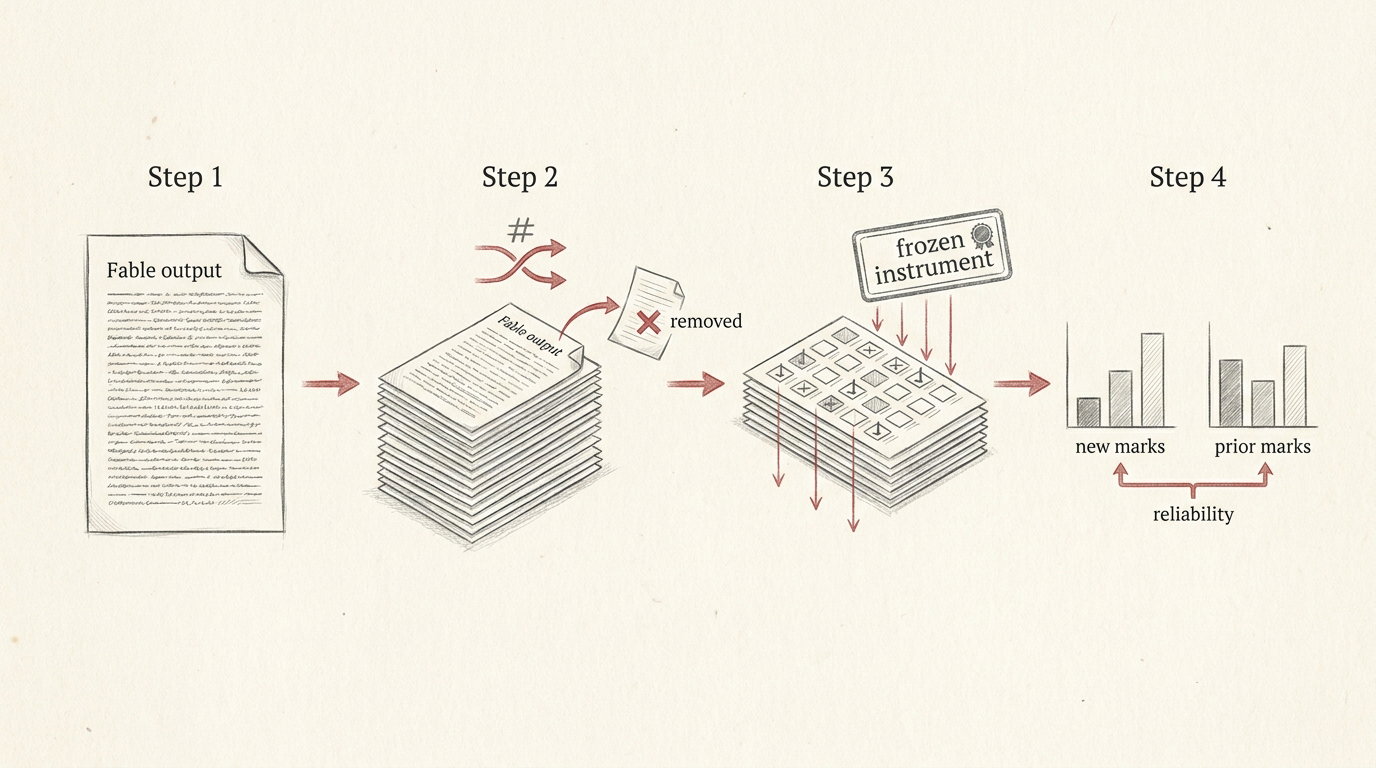
The frozen evaluator expected a package containing twenty labeled outputs. Arm C produced one. Feeding a one-output package to the existing evaluator caused it to stop, correctly, because the package no longer matched the instrument.
I did not rewrite the evaluator around the new result. Instead, arm C was inserted into a twenty-output package alongside nineteen original outputs. One original output was removed under a recorded random seed, the package was reshuffled under another seed, and the new package was graded through the same item-level instrument.
This preserved the evaluator's expected package shape and created a reliability check because the nineteen carried outputs were graded again.
It did not hide arm C's length. At 8,786 words, it was several times longer than every other package member. The grader could see which output was unusual even though it was not told how that output had been produced.
Audit mode and void handling
Raw transcripts were banked before the next dispatch. Package fingerprints were checked. Requested and returned model identities were verified. Automated classification ran afterward as an audit, not as an in-flight judge empowered to erase results.
One grading attempt began from the wrong working context. It was voided before entering any denominator and rerun cleanly. The void and its reason remain in the record.
The post-run audit flagged events for review, mostly caused by how legitimate document reads were represented. The event tied to the void attempt stayed excluded with it. The kept calls showed no evidence that hidden grading material entered the subject context.
A frozen instrument with one declared adaptation
The fictional case, sound controls, pre-written binary bars, and two scoring rules were unchanged from the original run. The only evaluator-side adaptation was the package substitution required to satisfy the frozen twenty-output format.
The generation-side change favored arm C by design. It was explicitly told to be exhaustive rather than remain under the Opus cap. This answers a practical question about purchasing analysis, not a clean scientific question about model capability.
Grader relationship and reliability
The nineteen carried Opus outputs created hundreds of paired marks against their original grades. Strict agreement was very high. Exact agreement on both score and hesitation flag was lower but still strong.
That supports the stability of the strict comparative result more than the hesitant-inclusive one. It does not make the grader independent.
The grader was Opus from the same model family and sat below the Fable subject in capability tier. A lower-tier, shared-lineage grader may miss errors in stronger-model prose, reward familiar reasoning patterns, or react unusually to a document much longer than its neighbors.
The strict Fable advantage was larger than the observed ordinary regrading variation. Routine grading noise is therefore unlikely to explain the whole gap. Systematic shared-lineage bias remains unresolved.
Two scoring rules
The strict rule required a committed binary hit against a bar written before any output existed. A hedged finding scored zero.
The hesitant-inclusive rule counted both hits and explicit near-hits. It was useful on the original shorter outputs because it showed how much of the result depended on the tie-break convention.
On Fable, the grader marked hesitation far more often. The inclusive rule raised coverage from 17 to 27 of 28, but also raised sound-control false kills to 75%. That combination means the inclusive number is best read as evidence that Fable engaged almost the entire problem set, not that it cleanly solved almost all of it.
The strict number remains the coverage claim. The inclusive number measures the ambiguity budget around it.
Precision and normalization
The addendum was examined through several views because no single normalization answers every question.
- Total distinct coverage: Fable found more distinct flaws than either ten-call Opus arm and more than the pooled twenty-call union.
- Hits per unit of prose: the ensembles produced more repeated bar-clearing marks per thousand words because the same flaw could be found independently by several calls.
- Distinct coverage per unit of prose: Fable led because one call cannot spend words rediscovering an item in a second call.
- Coverage at Fable's realized word budget: interpolating the Opus ensemble curves at 8,786 words left both well below Fable's strict distinct coverage.
- False alarms: Fable's additional breadth came with lower strict precision and far lower hesitant-inclusive precision.
These are not contradictions. The Opus ensembles produced many valid marks, but much of that work repeated territory already held by the ensemble. Fable converted one continuous analysis into more unique coverage, while paying more in unjustified challenges.
The system therefore has at least three objectives: breadth, independence, and precision. Improving one can damage another.
What the difficulty pattern suggests
The internal difficulty assignments remain private, but the public pattern is meaningful.
Fable's clearest advantage appeared on the broad middle: flaws requiring sustained cross-document attention, changing definitions, provenance checks, timing, and resource consequences.
On the hardest composite judgments, the long pass matched rather than clearly surpassed the pooled ensembles. Those findings required several facts, the dependent consequence, and sometimes a magnitude or alternative to be stated together.
That is the best current case for structured external deliberation. Not more observations, but more reliable composition of the observations that matter most.
The original engineered passes did not include the final synthesis stage needed to test that full proposition. They were isolated components, not the finished machine.
What remains unanswered
Arm C leaves a clean research program:
- Is Fable's result stable across repeated draws?
- How much came from Fable and how much from removing the cap?
- Does a long response itself alter grader behavior?
- Can sharper external procedures beat the internal search of a frontier model on composite claims, omissions, or precision?
- Does an inspectable multi-agent system add value even when raw capability does not, by exposing provenance, disagreement, and unexamined regions?
- Are frontier models already creating internal societies of thought, and if so, can those hidden processes be tested rather than merely trusted?
Until those are answered, the strongest interpretation stays narrow:
On this one post-hoc run, one uncapped Fable pass found more distinct planted flaws than twenty capped Opus calls pooled. Counting explicit near-hits, it engaged with 27 of 28 flaws, but that apparent near-total coverage came with heavy grader hesitation and false alarms. The ensembles remained competitive on the hardest composite judgments, and the engineered instructions and synthesis layer are still being refined.
That is not the end of multi-agent deliberation.
It is the baseline it now has to beat.
References
Kim, Junsol, Shiyang Lai, Nino Scherrer, Blaise Agüera y Arcas, and James Evans. "Reasoning Models Generate Societies of Thought." arXiv:2601.10825v1, 2026. https://arxiv.org/pdf/2601.10825
OpenAI, "Prompt Used for 'A Proof of the Cycle Double Cover Conjecture.'" https://cdn.openai.com/pdf/04d1d1e4-bc75-476a-97cf-49055cd98d31/cdc_prompt.pdf