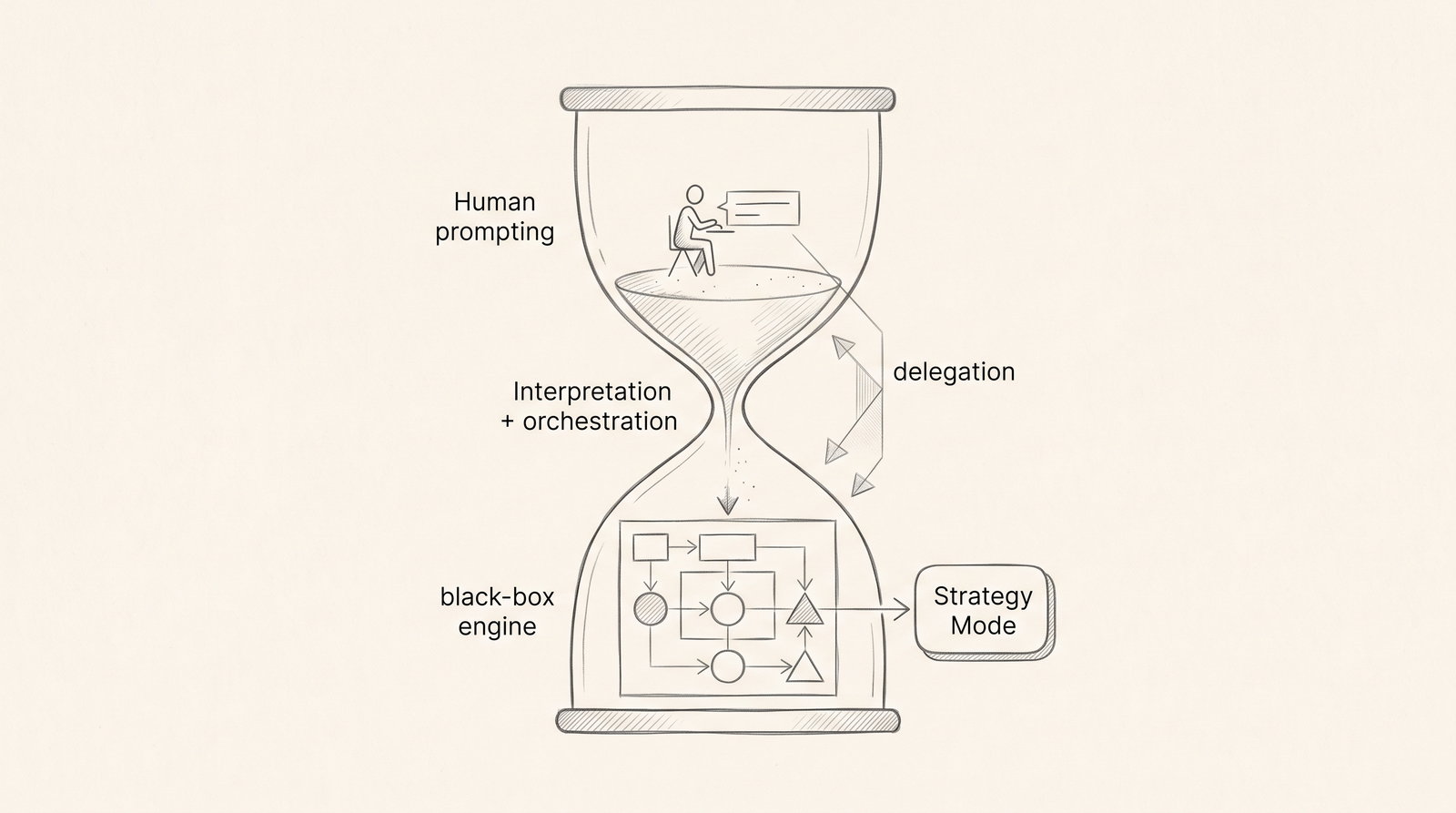
A few days ago, I watched Anthropic’s Fable take a task in co-work mode and design its own delegated, multi-agent workflow.
I had not handed it a finished orchestration. I had not specified every role, every handoff, or every adversarial check. The model inferred that the task needed decomposition and began constructing the system itself.
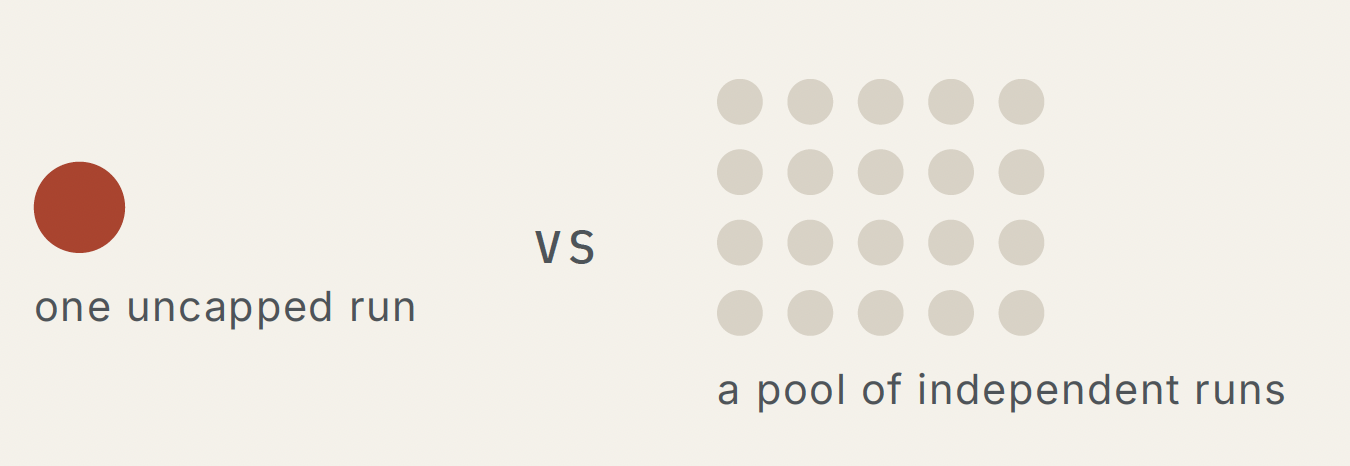
I understood that moment differently after my latest experiment. In one controlled flaw-detection benchmark, using the same fictional acquisition case and strict scoring rubric, an uncapped Fable 5 run found 17 distinct planted flaws while twenty pooled Opus 4.5 runs found 14. I had been investing in the idea that careful prompting plus orchestration could reliably extract something a single model call could not. I saw evidence that a frontier model could absorb parts of both, and now I saw evidence that the model could also run it’s own delegated orchestration if it needed to…
There is still a market for better prompts. By prompting, I mean the high-skill work of designing instructions and workflows, not the ordinary act of asking a model a question. I am no longer convinced that specialty is durable.
The bottleneck became the user
Models are becoming capable of more deliberation than most people know how to request.
Recently, I used a model to design a multi-step workbook for a deep analysis with a frontier model. The result was a nine-page instruction manual, written in dense, concise language just to explain what to do. That's no longer a “prompt.”
Right now, a frontier model can carry out long, branching analyses with tools, intermediate artifacts, verification steps, and repeated revisions. But extracting that capability can take hours of preparation. Someone has to define the real question, surface hidden assumptions, choose methods, set evidence standards, anticipate failure modes, and tell the model when to branch or stop.
I spent two hours doing that, but most users don't work that way. They type one sentence.
Faced with the power of frontier models, most users asking questions outside their areas of expertise don't know how to use that power. They don't know what to ask or how to ask it, or what system to build around the model to make its output useful. They rely on the model's inherent intelligence and hope for the best, often without knowing how to evaluate the result.
For a while, this creates an obvious opportunity. People who know how to construct detailed “prompts” and reusable skills can help others access capabilities that already exist but remain buried behind a weak interface. A good prompt can make a model look dramatically smarter by giving it the permission, structure, and room to use what it already knows.
But a product company won't leave its customers facing a prompt-writing exam forever. Once the gap between available capability and extracted capability grows large enough, the prompt itself becomes part of the product.
The labs will absorb the prompt
The logical response to weak human prompting is to move interpretation and orchestration into the backend.
Three forces point in the same direction. The cost of a given level of inference tends to fall while providers make larger inference budgets available. Models keep getting more capable. Most users are not likely to write three-page specifications before asking a question, and any human facing product will know not to ask them to.
The obvious product move is to let the model infer the missing work. A one-line strategy question can trigger a hidden process that audits the question, searches for inconsistencies, selects relevant methodologies, allocates a compute budget, creates adversarial perspectives, and decides which tools or specialist agents to invoke. The user does not need to know the names of the methods. The system estimates what kind of deliberation the request warrants within the user's cost and latency constraints.
A recent paper, Reasoning Models Generate Societies of Thought, suggests that part of this process may already be developing inside reasoning models. The authors report that reasoning-optimized traces display more questioning, perspective shifts, conflict, and reconciliation than instruction-tuned traces, even after controlling for trace length. In their reinforcement-learning experiments, small models rewarded for accuracy produced increasing conversational behavior without a direct reward for dialogue.
The model is not merely learning to follow a better prompt. It may be learning to generate the cognitive structure that the prompt was supposed to impose.
The missing middle
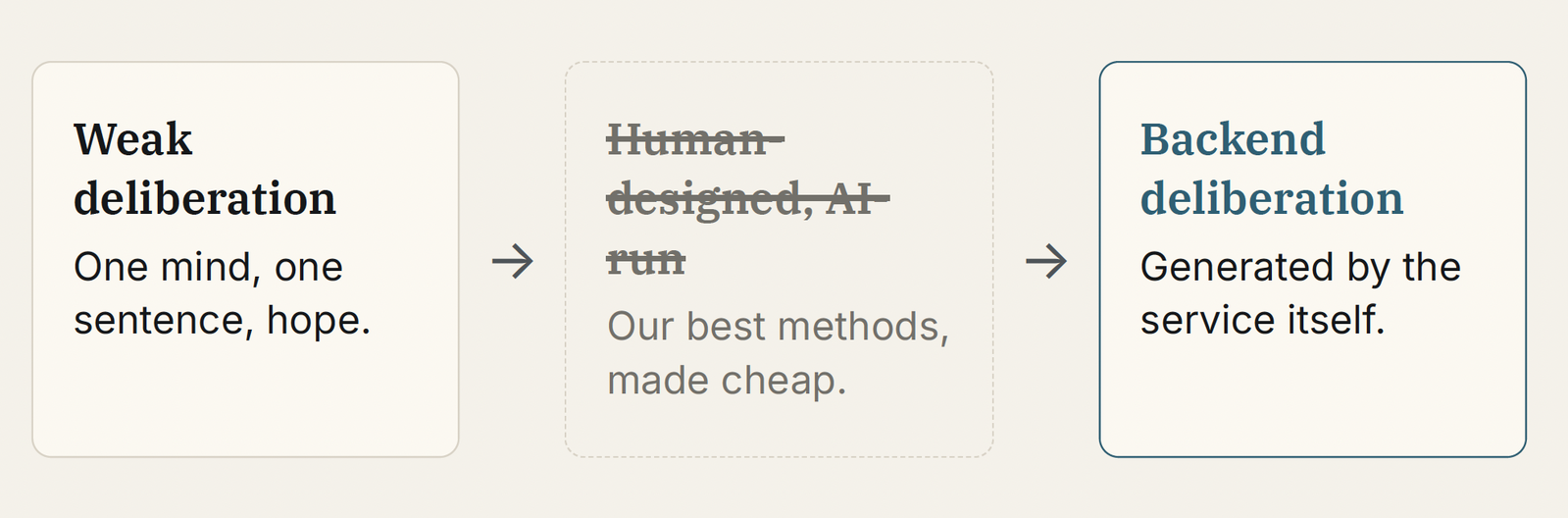
I expected AI to make a good human-designed deliberation process cheap. I think I’m wrong about that.
In a previous essay, I argued that we already know a great deal about how to make good decisions, but the problem is that serious deliberation is expensive. It takes time to frame the question, gather evidence, bring conflicting perspectives into the room, surface assumptions, and work through disagreement. AI, I thought, could lower that cost.
That implied an intermediate phase. We would design the right deliberative process - some combination of prompts, orchestration, analytical methods, adversarial checks, and deterministic controls - and then use AI to run it faster and more often. First we would teach machines our best ways of thinking. Later, perhaps, they would improve on them.
That was the plan.
What I see happening suggests that this middle phase may be compressed to zero.
Instead of moving from weak human deliberation to better human-designed, AI-assisted deliberation, we may leap directly to something else: highly sophisticated deliberation generated on the backend of a service, at a level most users could not have designed and may not be able to follow.
This is more than automation. An automated process does something we understand without requiring us to perform every step. The process I see emerging may choose steps we would not have thought to include, combine methods we do not recognize, and build internal structures more elaborate than the user's own model of the decision.
By the time the result reaches the interface, the user may not be practicing a better form of deliberation. They may be receiving the output of a deliberation they cannot reconstruct - unsure why it took that path, what alternatives it excluded, or what its sophistication actually means.
The leap is from not being able to run a serious deliberation process to depending on one that may be too advanced to understand.
Strategy becomes a button
Decision and strategy will become a product mode, not a prompting discipline.
Chat products already expose modes for web search and deep research. A decision mode is the natural next step. The user asks, "What should our marketing strategy be for this segment?" The interface offers a cost and a waiting time. Behind the button, the system spends whatever tokens and tool calls are justified to produce an answer.
The model may review the company's assumptions, construct alternative market models, challenge the available evidence, run scenario analyses, ask sub-agents to defend incompatible strategies, and run a task-specific analysis or simulation if the data supports one. None of this needs to appear in the initial request. The user's contribution may be no more than selecting the expensive toggle. That may be enough to initiate the process, but not enough to make its conclusions trustworthy.

This will feel like progress because it is progress. Better deliberation will become available to people who would never learn the craft themselves. The cost of rigor will fall.
It will also make prompting expertise resemble many temporary interface specialties. Valuable now. Educational in retrospect. Increasingly hidden by the product layer that learned from it.
Smarter than me is enough
Many people will delegate substantial parts of deliberation once the model is reliably better than their unaided alternative.
A strategy mode matters only if users are willing to defer to it, and the adoption threshold is lower than perfection. There is a familiar joke about escaping a tiger: you do not need to outrun the tiger, only the person next to you. The relevant benchmark for delegated reasoning is similar. A model does not need to be the wisest possible decision-maker. It needs to be better than the person asking, or better than what his competitors think he is capable of.
That threshold is much lower than perfection.
A manager who believes the model improves the odds will face growing pressure to use it. A company facing competitors who use strategy models will feel compelled to use one too. Once the model's recommendation arrives wrapped in exhaustive analysis, objections, scenarios, and confidence estimates, refusing it will become harder than accepting it.
The result is not just model-assisted decision-making. It creates a growing risk of model-to-model competition with humans formally retaining authority while practically delegating most of the deliberation.
The risk is not bad prompting
The deepest danger is that people stop practicing deliberation because the interface makes deliberation look finished.
Today, a weak prompt leaves visible clues. The answer is shallow. The omissions are obvious. The user knows, at least sometimes, that more work is required.
A backend “strategy mode” will remove those clues. It can produce an answer that looks as if every relevant angle was considered. The process may actually be excellent. But the user will have fewer reasons to ask what was excluded, which evidence dominated, or whether the generated critiques were meaningfully diverse rather than variations produced by the same assumptions.
Prompting at least forces someone to articulate the shape of the inquiry. When prompting disappears, that burden does not automatically move to the user at a higher level. It may disappear from the human side entirely.
This changes the opportunity for a lab devoted to computational deliberation. The near-term work is helping people use models more deliberately. The durable opportunity is not better instructions for models, but better institutions for humans who increasingly rely on them.
The prompting window may close quickly. It may also take with it the intermediate period in which humans learned to practice rigorous deliberation with machines.
The question it leaves behind is bigger:
What happens if we delegate deliberation before we have learned enough about good deliberation to understand what we are delegating?