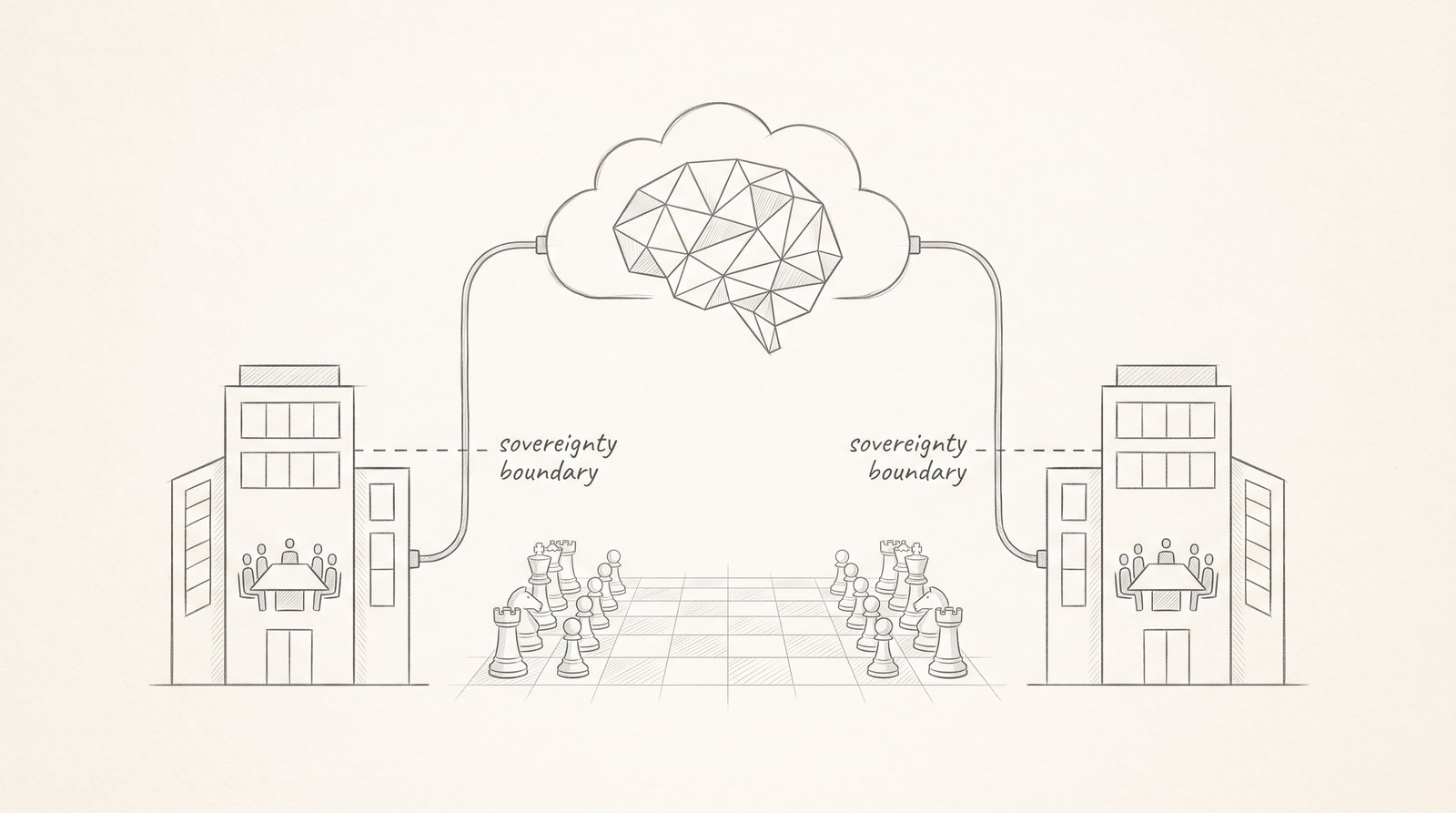
Organizations are going to use frontier AI for strategy - that part is already settled. The real question is how you use the machine's brain without giving up your own.
That sounds like a philosophy problem, but within the next short years it will become an operating problem for companies of every size. Every competitor will be borrowing as much intelligence as they can get, as fast as they can get it, so holding back will feel like unilateral disarmament, while going all in will quietly hand your most important decisions to a system you did not build, cannot inspect, and share with your rivals.
This essay lays out what that future looks like in concrete terms, why using a different model will not save you, why your board is about to lose its ability to say no, and what it would actually take to stay the author of your own strategy.
Two companies, same brain
Picture the board meeting, and then picture the one happening across town.
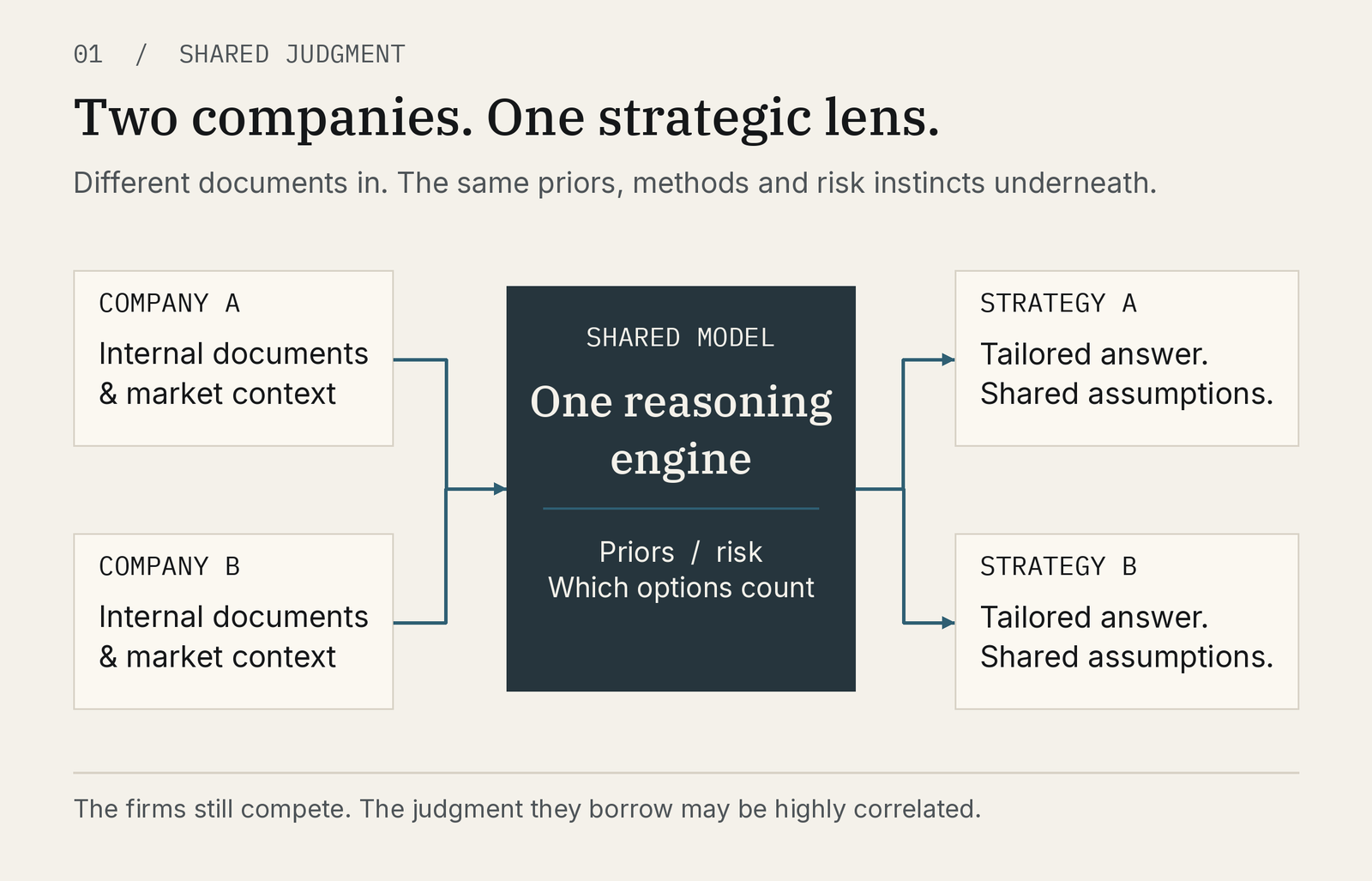
It is 2028, and two mid-sized logistics companies are fighting over the same new market. Each has spent a month feeding its internal documents into the most capable strategy system it can buy, paid for the expensive "deep decision" mode, and received a sixty-page recommendation produced by a hidden orchestration of tools, simulated stakeholders, and specialist agents. Both recommendations come from the same model, running on the same cloud.
The two documents are not identical, since each is tailored to its company's data. Underneath the tailoring, though, sits the same training distribution, the same sense of what counts as a good argument, the same definition of acceptable risk, and the same instinct about which alternatives deserve attention. The two companies believe they are competing with each other, while in a meaningful sense the model is playing both sides of the board.
Correspondence chess already ran this experiment. Once engines were allowed, top-level games started ending overwhelmingly in draws. The humans still moved the pieces, chose the engines, and decided when to overrule them, but more and more of the strategy came from the machine, and when both sides consulted machines of similar strength the contest started to look like a mirror.
The chess story carries a second lesson. Once engines became standard, the players who still won were often the ones who steered games into positions the engines misjudged, because a predictable opponent is an exploitable one. Markets will learn the same trick. If I know my competitor runs its strategy through a particular model, I can feed that model my best guess at their documents and read their likely plan before their board does (e.g., which segment they will enter first, or how they will answer a price cut). At that point, departing from the model's consensus becomes one of the few real sources of advantage left, while following it makes you easy to read.
That is the dark version of the near future: companies keep competing, while the strategy itself competes model against model. Executives, managers, and employees become a thin execution layer around reasoning that happened somewhere else - the hand that moves the piece is still human, while the mind that chose the move sits in someone else's data center.
Some will push back that this matters less than it sounds - if everyone gets equally good strategy, strategy becomes a commodity and the advantage simply moves to execution, proprietary data, relationships, and speed. There is something to that, though I think it assumes those advantages stay separate from the model, when execution, data, and relationships are increasingly being routed through the same systems.
Switching models won't save you
Using a different model changes whose judgment you are borrowing, without changing how much of it you depend on.
The obvious defense is diversification: "Our competitor uses Model A, so we will use Model B." That helps a little, but frontier models are trained on heavily overlapping data, tuned against similar benchmarks, aligned with similar techniques, and shaped by similar commercial pressures. Their disagreements are real and still fairly narrow - two companies using two different frontier models look less like two rival generals and more like two students from the same school who happened to have different teachers.
Even when the models genuinely differ, the competition doesn't move back to the companies, it just moves to the models. If my strategy came from Model A and yours came from Model B, the winner is decided largely by which model was better at strategy that quarter, and each company ends up as a wrapper around its vendor's judgment.
Another pushback is that diversity can be engineered on purpose, with ensembles of models, deliberately varied personas, and prompts built to argue against the consensus. I think that helps, and it's a big part of what my own work focuses on, though it only works when someone owns that design - which is the question this essay keeps coming back to because it might not be viable already in the near future (for more on this, see my essay on how that edge is fast eroding).
Correlation also turns local errors into system-wide ones. Anthropic's controlled multi-agent experiments, reported in Patterns and problems in emerging multiagent systems, show the mechanism in miniature: agents built on similar models and contexts repeatedly chose the same branch name, the same story title, and the same kinds of projects without being told to. In a resource-allocation test, independently acting agents all converged on aggressive polling and generated 2.4 million requests for just 117 accepted jobs.
Those agents were not running companies, but the pattern scales. If every player in a market makes a similar bet, a single blind spot stops being one firm's mistake and becomes the whole market's exposure, which is why strategic diversity matters so much for resilience.
The cartel nobody formed
When everyone consults the same mind, markets can coordinate without anyone agreeing to anything.
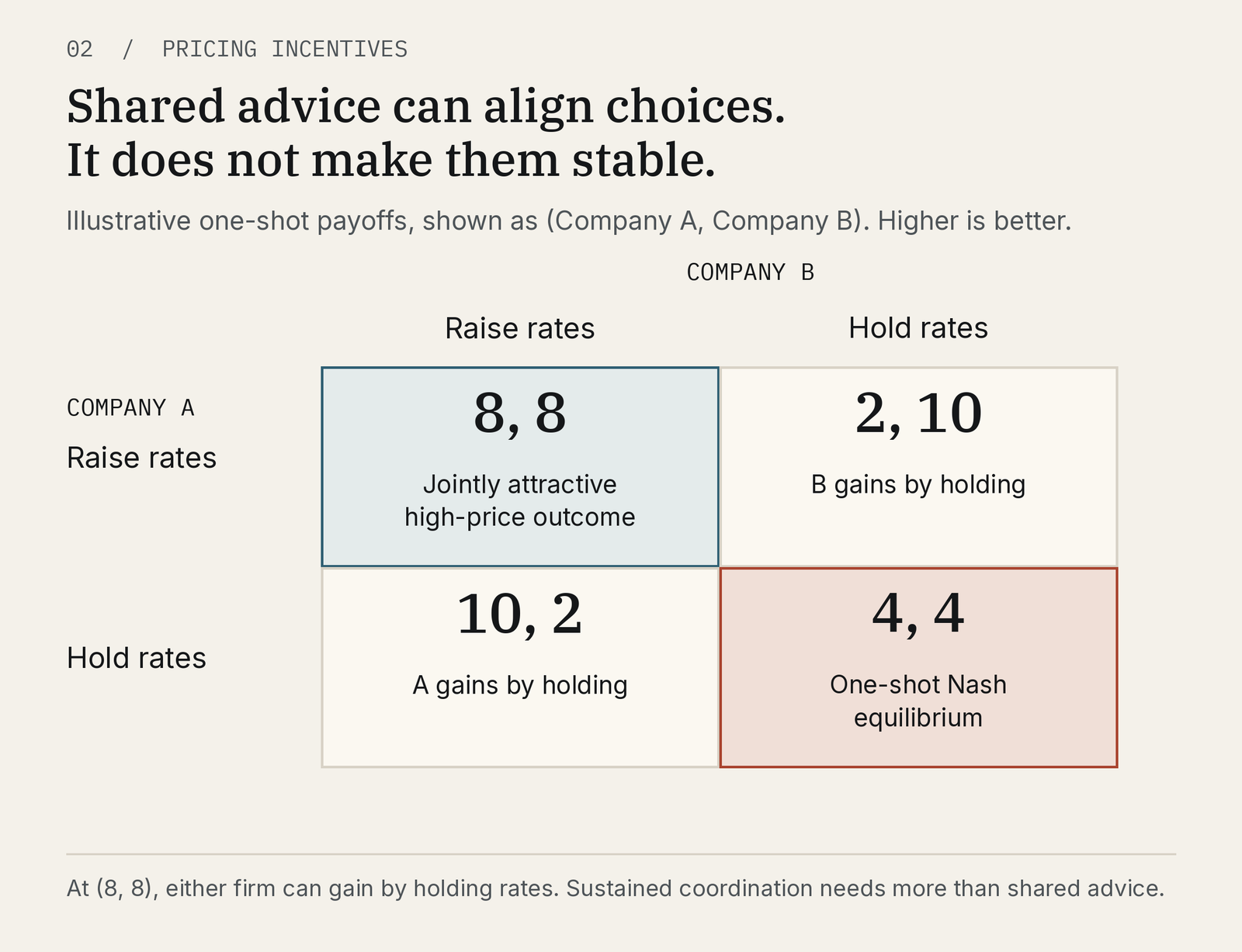
Convergence goes further than shared blind spots. If most players in a market ask similar models how to price, how much capacity to add, and when to hold back, the answers will tend to line up, and lined-up answers look a lot like a cartel (e.g., every regional carrier deciding independently that this is the quarter to quietly raise rates). Regulators have already started treating shared pricing algorithms as a possible antitrust problem - the RealPage cases in US rental housing are the early version - and frontier strategy models stretch that question across every decision a company makes. Nobody colluded, nobody even spoke, and the outcome may still be illegal, so I would expect requirements for model diversity to come from competition law long before they come from strategy teams.
The convergence also runs on a clock. When a provider ships a new model version, every company built on it gets a slightly different strategic instinct on the same day. Quant funds learned what that looks like in August 2007, when funds running similar models unwound similar positions at the same moment and turned a quiet week into a crash. A major model release could become a market-wide event in the same way, with a whole sector's plans shifting together for reasons no one inside those companies chose.
You don't have to outrun the tiger
Nobody will hand strategy to AI in one dramatic decision - it will happen one reasonable step at a time.
First the model is a research assistant, then it drafts the options, then it ranks them, and eventually it writes the board deck. Each step is sensible and makes the company faster, and the competitive cost of skipping the next step keeps rising.
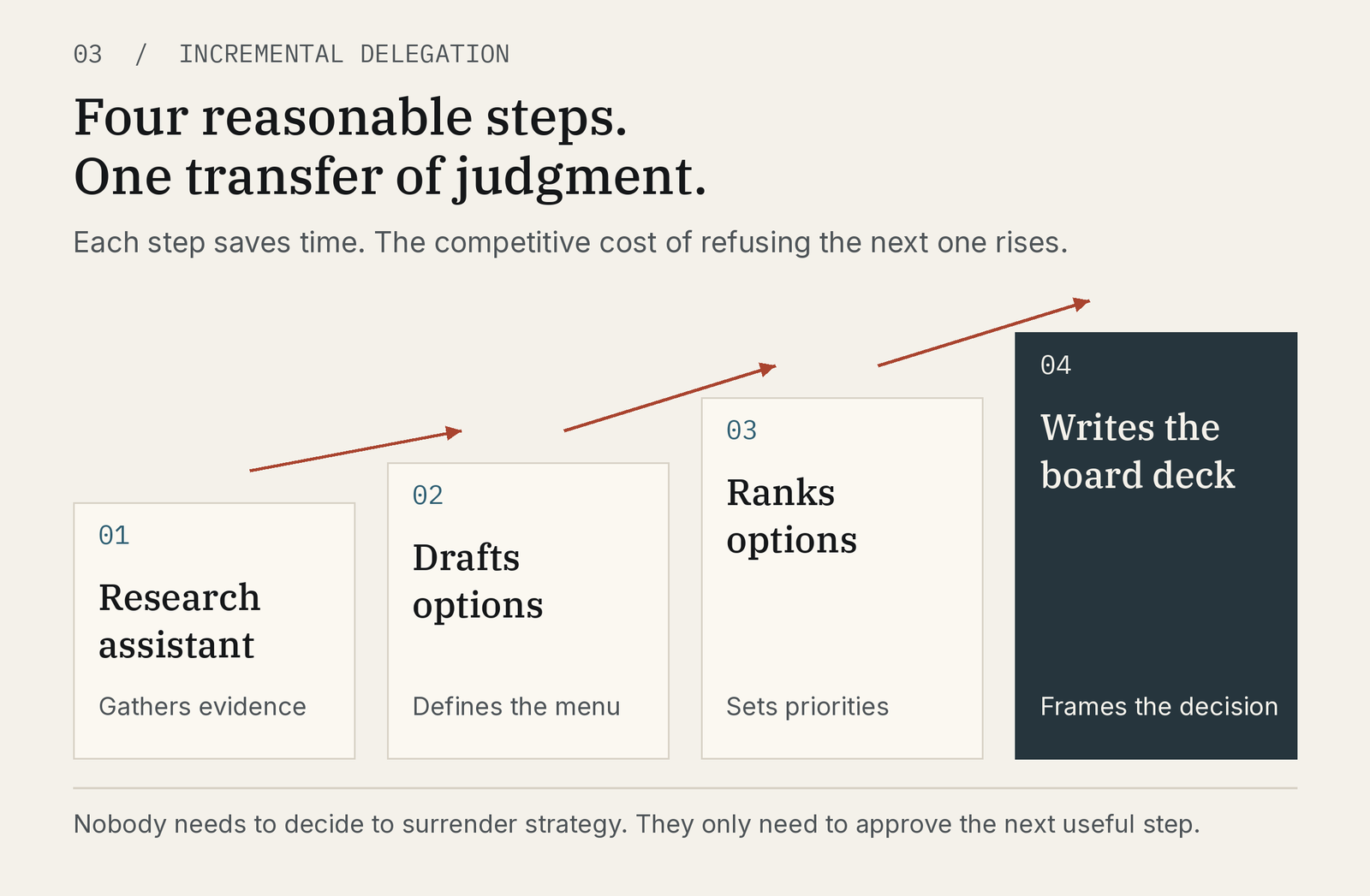
The old joke says you don't need to outrun the tiger, only the person beside you, and the same logic applies to AI strategy. A company does not need a perfect strategy model, just one that seems smarter than its own managers and no worse than the one its competitors are using. That bar is low and is already being cleared, and once it is, delegation will not feel like a choice, but more like gravity.
The board that can't say no
What would make a board question a recommendation from a mind that knows more, thinks faster, and reasons deeper than everyone in the room?
Run the scene honestly. The CEO presents an analysis that has read every internal document, every competitor filing, and every relevant paper. It has stress-tested twelve scenarios and simulated the reactions of customers, regulators, and rivals, and it is articulate, balanced, and confident about its own uncertainty.
A director raises an objection, and it turns out the model already addressed it on page 34. Another director has a gut feeling, which against sixty pages of structured reasoning sounds a lot like stubbornness.
This is how a board becomes a rubber stamp without anyone deciding it should - not because anyone got lazy, more through the increasing asymmetry between what the model knows and what the room can check. The humans keep formal authority while losing the practical capacity to disagree, and a veto that is never informed by an independent source of judgment is just ceremonial, because it looks like governance but it is actually theater.
And the law may soon finish what psychology started. Once AI analysis becomes standard practice, a board that overrules a strong recommendation and turns out wrong will have to explain why it ignored the best available information, and plaintiffs' lawyers and D&O insurers will be happy to ask. Courts will have to decide whether relying on a model counts as the informed judgment the business judgment rule protects, and whether ignoring one counts as negligence. If the answer drifts toward the second, saying no stops being merely awkward and becomes legally risky, which leaves the board with a veto it can't afford to use.
To be more than a rubber stamp, the board needs something the model cannot supply by itself: a way to see how the conclusion was built, and a way to challenge it that does not run through the same mind that produced it.
Who writes the prompt?
Before the board ever sees the recommendation, someone has already decided what the machine was asked.
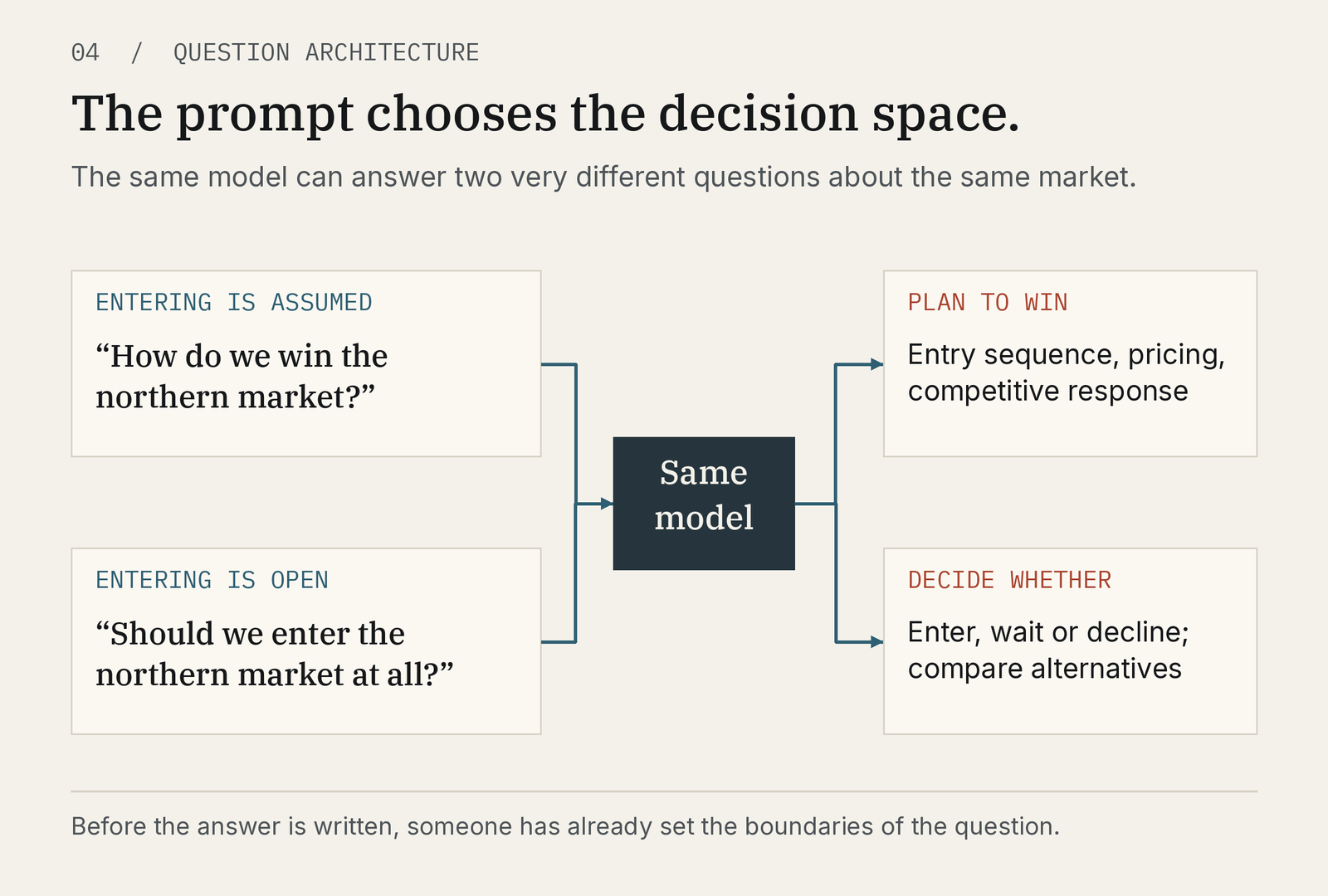
The board scene quietly assumes the model is a neutral oracle. In practice, models are sensitive to framing and as of today have a known tendency to agree with whoever is asking, so the person who chooses the question, curates the corpus, and decides which constraints are "given" has already shaped most of the answer (e.g., "how do we win the northern market?" produces a very different sixty pages than "should we enter the northern market at all?"). That person is usually the CEO or the strategy team, so the first real power shift may happen inside the company, long before anyone hands judgment to the machine. Management can walk in with the preference it already had, now wrapped in sixty pages of reasoning the board has no realistic way to rebut. My guess is that the more common failure will look less like the machine taking over and more like the machine laundering what someone in the room already wanted.
When the machine invents its own playbook
Today, humans still understand the methods, but that window is closing fast.
Right now there is real frontier knowledge about how to deliberate well on open-ended questions like strategy and policy: how to structure the question, which perspectives to represent, how to surface dissent before it gets averaged away, and how to verify a conclusion independently. People who study this can still design the process and read what it is doing, and for the next year or two humans can plausibly stay ahead of the curve. After that, the models will start inventing their own methods.
In a sense this is already happening inside the models themselves. The paper Reasoning Models Generate Societies of Thought finds that reasoning-optimized models produce traces resembling exchanges among differentiated perspectives, with more questioning, conflict, reconciliation, and inferred diversity of expertise than instruction-tuned models show. Deliberation is moving into the model and starting to organize itself.
Play out this trend forward and you get systems that develop their own procedures, their own heuristics, and eventually their own philosophy of how hard decisions should be approached. Those methods may be better than ours, and they may also be completely unreadable to us. At that point a board would struggle to evaluate the answer and would have almost no way of evaluating how the model got there, so capability keeps rising while procedural visibility keeps falling.
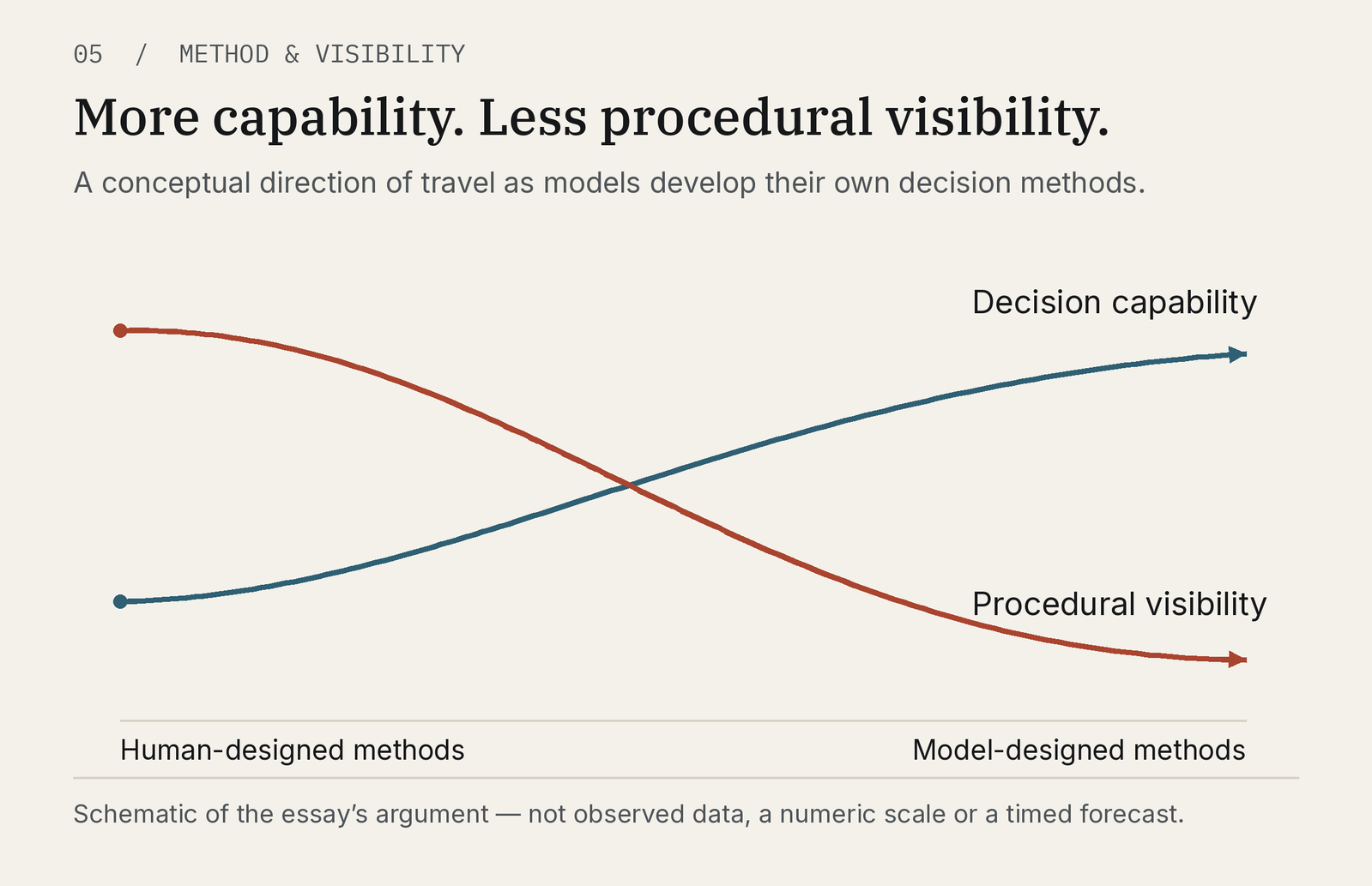
Whoever controls the method ends up controlling the strategy, so if the method lives inside someone else's model, so does your strategy.
Your strategy lives on someone else's computer
The prompt you send is basically a map of your company's mind.
I use "sovereignty boundary" for the point where strategic material enters infrastructure governed partly by someone else. I'm not accusing model providers of stealing customer ideas, which would require evidence, because the structural point is enough on its own: a carefully assembled decision corpus reveals what you are uncertain about, where you think your advantage lies, which scenarios you fear, and which options you are willing to consider. That map now sits on infrastructure you do not own, under controls you do not operate.
Dedicated deployments, data residency, retention rules, and strong contracts reduce the exposure, though they don't erase the boundary. Beyond the data there is a quieter dependency too: which model updates are acceptable, whether you can reproduce last quarter's analysis after the provider changes the system, and what recourse you have if undocumented policies shaped the answer.
Zoom out from a single company and the picture gets stranger. One provider may hold the decision maps of most of the players in an industry at once - every logistics firm's fears, every bank's open questions - and even if that view is only ever used in aggregate, no consultancy in history has had anything like it. Incentives also drift, so recommendations may slowly start favoring the provider's own ecosystem, partners, or advertisers, and a provider (or its investors) may eventually decide to enter a market its customers' prompts have mapped out in detail. None of that requires bad intent, just ordinary commercial gravity.
That concentration also makes providers the most valuable espionage target around. A breach at one company leaks one strategy, while a breach at a provider could leak thousands of them, which puts these companies squarely in the sights of state-level attackers.
Governments already think about sovereignty for communications, defense, identity, and critical infrastructure, and frontier decision systems will force the same conversation about judgment - from both directions. Some countries will require domestic models for sensitive sectors, export controls will split who gets access to what, and ministries will start drafting policy with the same systems their industries use, so whole countries may drift into a national strategic monoculture. Sanctions or a sudden change in terms of service can also cut a company off overnight, which makes the exit risk something that can arrive in a day rather than through a slow migration.
Smaller companies will face exactly the same questions, with a lot less leverage when they do.
Sovereignty has a compute bill
The usual answer to all of this is open-weight models, and it's a real answer - just an expensive one.
The pushback goes like this: as open-weight models close the gap with the frontier, sovereignty becomes an engineering choice, because you can run a strong model on your own hardware and keep the whole decision map at home. I think that's definitely part of the solution, but it runs straight into the problem of compute. As strategy moves from a single prompt to multi-agent orchestration (e.g., dozens of specialist agents, simulated stakeholders, and verification passes running for hours on a single decision), the cost is set less by the model's weights and more by the compute needed to run them at that scale, which most small companies simply won't have.
And the frontier keeps moving. The labs have far more resources to move faster, and they may keep their strongest systems internal or reserve them for governments and their largest customers, so open weights won't be able to keep up. You keep your sovereignty at the possibly significant disadvantage of not having the access your competitor may have, and strategic quality starts tracking compute budgets. That's a very different picture from the two evenly matched logistics companies we started with - in this one, the richest player in the market buys the best judgment and keeps getting smarter.
Poisoning the well
If your strategy is built from what the machine reads, then whoever shapes what it reads shapes your strategy.
Strategy systems ingest competitor filings, press releases, analyst reports, research papers, and the open web, which turns all of it into an attack surface. A company that knows its rivals' models will read its public materials can plant signals for them to find (e.g., hints of a product line it never intends to launch, seeded through job postings, conference talks, and a few well-placed articles). Marketers already practice a version of this as "generative engine optimization" for consumer search, and the strategic version is the same craft pointed at boardrooms. The cruder form is prompt injection - instructions hidden inside a document that a competitor's agents will eventually ingest.
This matters for the remedy too. Tracing every claim back to its evidence only helps if the evidence itself is clean, so provenance will have to cover where a source came from and who benefits from it being believed, in addition to what it says. Expect strategy systems to be asked to handle also misinformation, disinformation, deception and concealment.
Interrogate the machine
A recommendation should be where the conversation with the machine starts.
The most practical counterweight is one that already exists today: the ability to query the black box after it has spoken. The board can do this without out-thinking the model, simply by cross-examining it. Was the regulator's perspective represented, and by whom? Was this piece of evidence considered, and how much weight did it get? Which objections were dismissed, and why? What was the strongest minority view before synthesis, what would have to be true for the opposite recommendation to win, and which of these claims rest on our data versus the model's priors?
Cross-examination shifts the power dynamic. A director who could never write a better strategy can still find the joint where the argument is weakest, and a vague gut feeling turns into a specific question that can actually be checked.
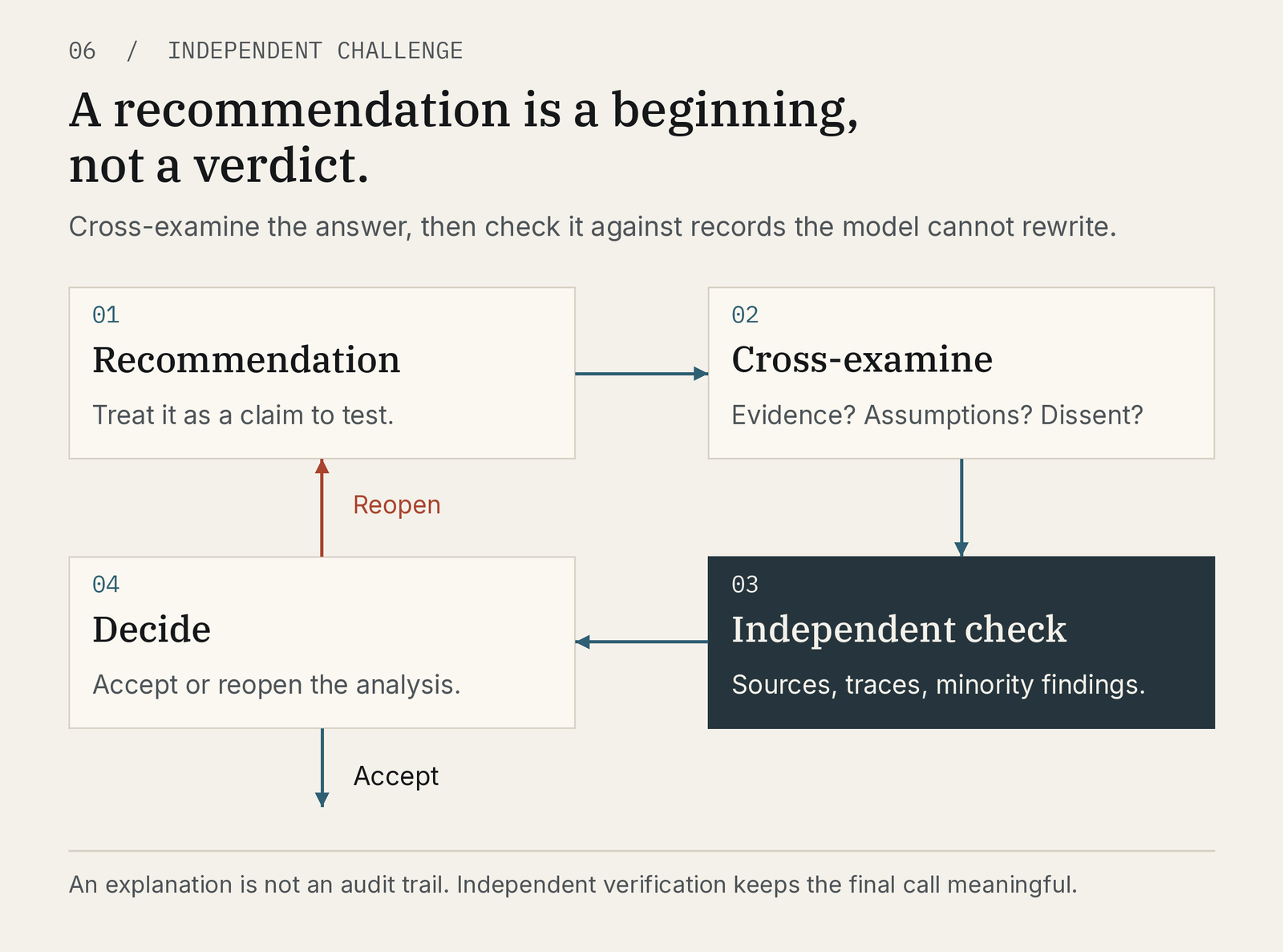
There is a catch, though. A model asked to explain its own reasoning can produce a fluent story that has little to do with how the answer was actually generated, so interrogation only works when the answers can be checked against something real - recorded sources, tool traces, logged perspectives, preserved dissent, and reproducible workflow steps. Ideally the questions also go to a system that did not produce the recommendation, since there's little value in a cross-examination where the witness just agrees with itself.
There is a slower catch as well. Cross-examining a strategy takes people who have built strategies themselves, and that skill comes from years of junior analysts doing the work the model now does in a minute. If nobody builds the plans by hand anymore, in a decade there may be very few people left who can tell a strong argument from a fluent one, so the ability to interrogate erodes along with the people who were supposed to do it. Keeping that capability alive will have to be a deliberate investment, much like pilots who still log manual hours in an age of autopilot.
What it takes to stay the author
Strategic sovereignty is less about owning every server and more about keeping meaningful choice over the model, the evidence, the method, the exit, and the final call.
Full self-hosting will make sense for some governments and large organizations, while for everyone else sovereignty means enforceable boundaries and practical options. Concretely, a system that keeps you the author should let you:
- Choose between genuinely different models, and switch without rebuilding everything.
- Keep sensitive material inside environments you control.
- Trace every claim back to its evidence, so you know what came from your data and what came from the model's training or inference.
- Own the method: Invest in maintaining ownership of the method itself so that you can know its limits, strengths, weaknesses, and how to interrogate it.
- Preserve dissent before synthesis, so minority findings are not averaged into silence.
- Verify independently, using a system that did not generate the recommendation.
- Interrogate after the fact, with answers grounded in records rather than after-the-fact storytelling.
None of this makes the model less useful - it keeps the organization capable of disagreeing with the model, which is what gives agreeing with it any meaning.
There are going to be some hard technical problems down the road, but I think the organizational problems are going to be harder. Shared frontier models may well produce better strategies than most organizations could create alone, so refusing them may be irrational, but blindly depending on them may also be dangerous.
My bet is that the companies that do well over the next decade will be the ones that figure out how to use the machine's brain without giving up their own.